SETHER
Blockchain-arbitrated transparency between brands and agencies. $22M whitepaper raise, MVP showcased at Cannes Lions Innovation Hall 2018, demo commitments from Adidas, SkyTV UK, and P&G.
Project Overview
Problem:
Digital advertising runs on trust that isn't backed by anything. Brands don't trust the numbers agencies report. Agencies do the work and wait months to get paid, often while clients change the goalposts mid-campaign.
What I did:
- User research, two-sided (agency interviews + brand interviews)
- Product architecture & UX design
- UI for the campaign-monitoring dashboard
- Brand identity & positioning
- Cannes Lions Innovation Hall pitch materials
TL;DR
- Challenge: Close the trust gap between brands and media agencies: verified performance, locked goals, automatic settlement.
- Scope: Product design, brand identity, two-sided user research. The first product I’d worked on that was meant to outlive a single campaign.
- Approach: Blockchain escrow that ties payment release directly to verified KPI performance. Hit 80% of your targets, 80% of the budget unlocks. Beat them, bonuses fire automatically.
- Outcome: $22M raised on the whitepaper alone (John McAfee on as Advisor). MVP showcased at Cannes Lions Innovation Hall 2018. Demo commitments from Adidas, SkyTV UK, and P&G.
Digital advertising runs on trust that isn’t backed by anything. Brands spend millions on campaigns and never quite believe the numbers agencies report. Are those impressions real? Did the campaign actually perform? Meanwhile, agencies do the work and wait weeks (sometimes months) to get paid, often while the client changed the goal mid-flight and blamed them for missing it.
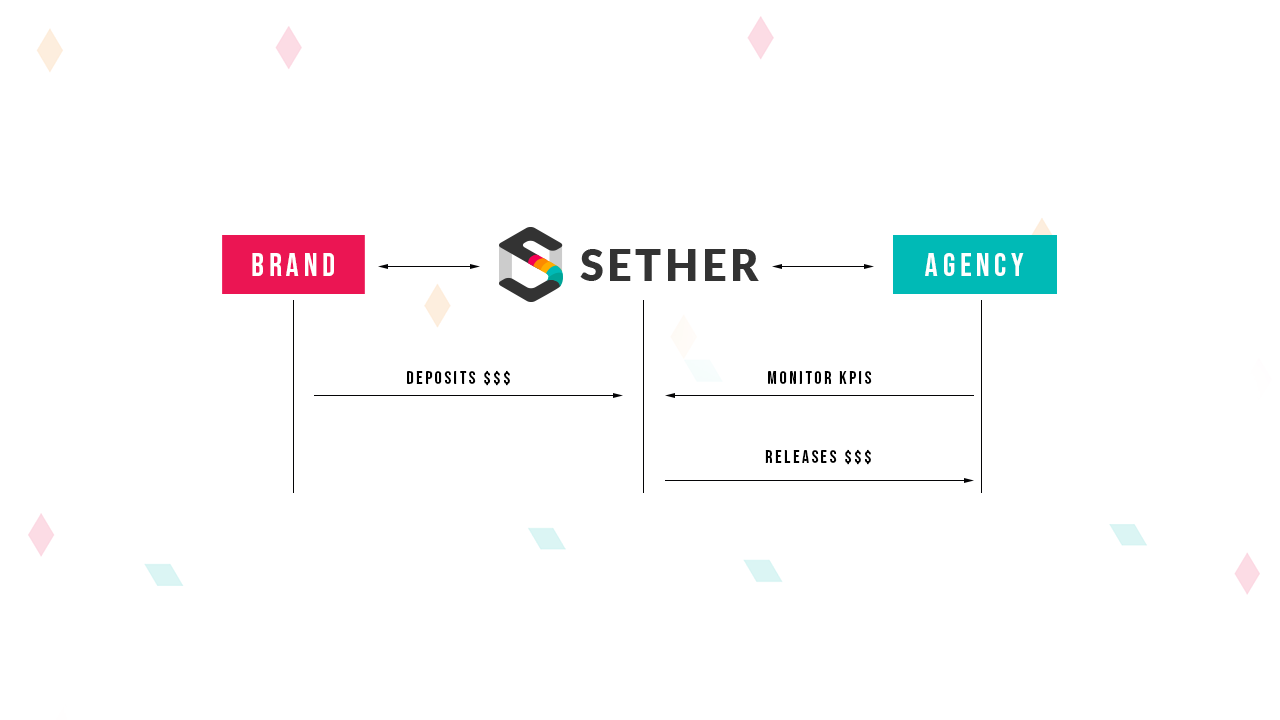
SETHER was designed to fix both sides of that broken relationship. Built on blockchain, it acted as an impartial arbiter between media agencies and their clients. Set your KPIs upfront, lock them into a smart contract, monitor the campaign through verified data, release payment automatically based on actual performance.
Hit 80% of your targets? 80% of the budget releases immediately. Exceed expectations? Bonus payments trigger automatically. No arguments, no delayed invoices, no “but you changed the brief” conversations.
I joined as Product Designer with extra responsibility for brand identity. I’d been the agency employee waiting for payment. I’d watched campaigns derailed by mid-flight client pivots. This wasn’t just a design project. It was solving problems I’d lived through. And it was the first product I’d ever worked on that was meant to outlive a single campaign. After eleven years of building things that vanished the day the media plan ended, that mattered to me more than the brief did.
Methods
Research: both sides of the table
My agency background gave me something that’s hard to fake on a research plan: I could pick up the phone and get honest answers from media buyers, campaign managers, and agency directors who would have given a stranger a polished PR version. I built a structured interview around two audiences, each with its own set of fears.
Agency side:
- How do you currently monitor campaign performance?
- What metrics matter most vs. what clients ask for?
- What’s your biggest frustration with client relationships?
- How long do you typically wait for payment?
Brand side:
- What do you actually need to understand about campaign performance?
- How do you currently validate agency-reported numbers?
- What information do you wish was translated into business terms?
The key insight
The same two pains came back in nearly every conversation. Paraphrased from the agency-side interviews:
“Clients always want to change things mid-campaign, then blame us when results suffer. If the goals were locked in from the start, everyone would be accountable.”
“We do the work in April, invoice in May, and maybe see payment in August. Sometimes later.”
And from the brand side:
“Agencies give us big numbers, millions of impressions, but I can’t connect that to business outcomes. I need translation, not just data dumps.”
“I never know if I’m getting what I paid for until it’s too late to do anything about it.”
The validation was immediate. Even at concept stage, both sides got excited the moment we sketched the mechanic. Agencies liked the locked objectives and the payment security. Brands liked the third-party verification and the performance-tied spend. People were asking when they could try it before there was a line of code.
Validation through whitepaper
Before building anything, we wrote the concept up as a whitepaper and published it on the blockchain platforms that mattered in 2018. It was meant to do two things: validate market interest and fund the build.
It did both, faster than anyone in the room had projected. John McAfee came on as an Advisor, the whitepaper landed in front of the audience that endorsement opened up, and the round closed at $22M. A number that, even in the 2018 crypto cycle, said the problem is real and the room agrees.
Funding closed, we moved straight into product development.
Architecture
The architecture needed to handle several complex workflows:
Campaign Setup Flow:
- Brand and agency agree on campaign parameters
- KPIs are defined and locked into a smart contract
- Budget is deposited into escrow
- Social media channels are connected for monitoring
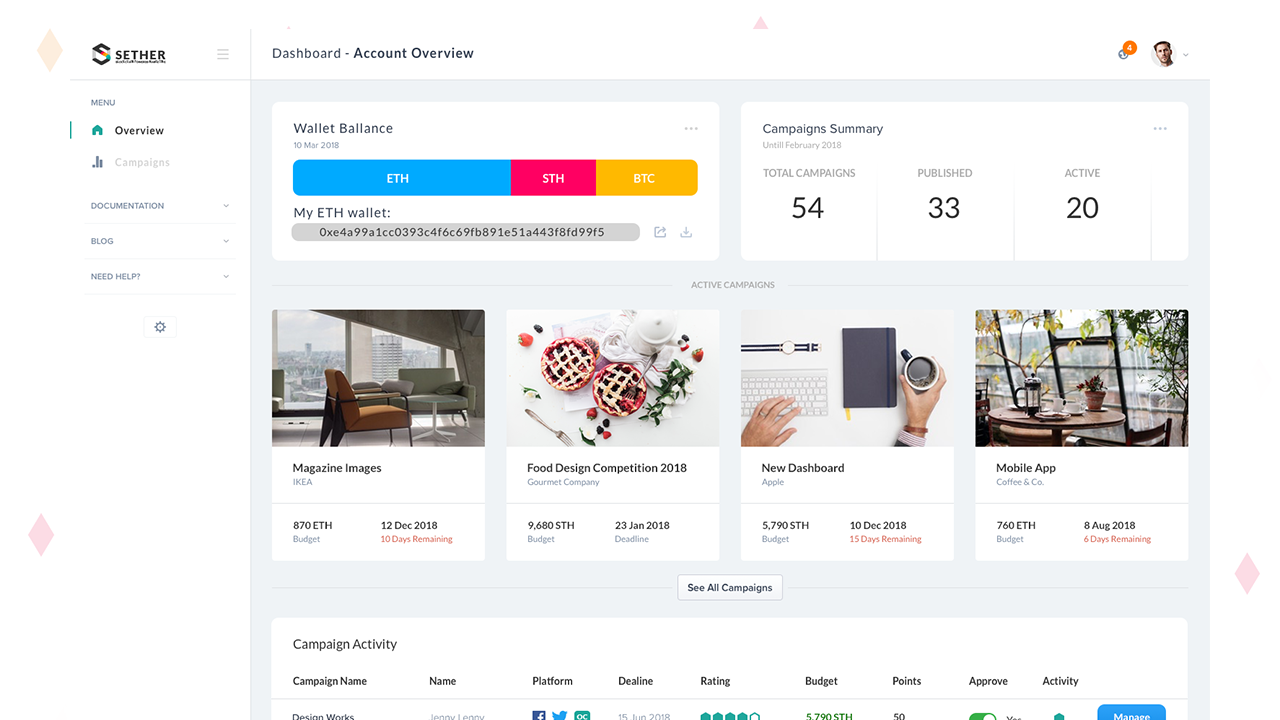
Monitoring dashboard. Both parties seeing the same verified data was the whole point, eliminating the “my numbers vs. your numbers” arguments. The dashboard pattern itself wasn’t reinvented. It owed a visible debt to the social-monitoring tools the audience already knew (Brandwatch, Sprout, the rest of the category). What was new was underneath it. The data pipeline was custom: Elasticsearch as the index, with sentiment categorization layered on top of the social-channel signals. That combination wasn’t off-the-shelf in 2018 the way it would be now, and it was the part that let the dashboard show both sides the same source of truth in close to real time.
Settlement Flow:
At campaign end, SETHER compares achieved performance against targets and calculates payment automatically:
- Under target: Proportional payment (80% achieved = 80% released)
- On target: Full payment released immediately
- Over target: Bonus payments triggered
I started with low-fidelity wireframes to map the information architecture. The challenge was presenting complex data, multiple social channels, various KPI types, real-time vs. historical performance, without overwhelming users who aren’t data analysts.

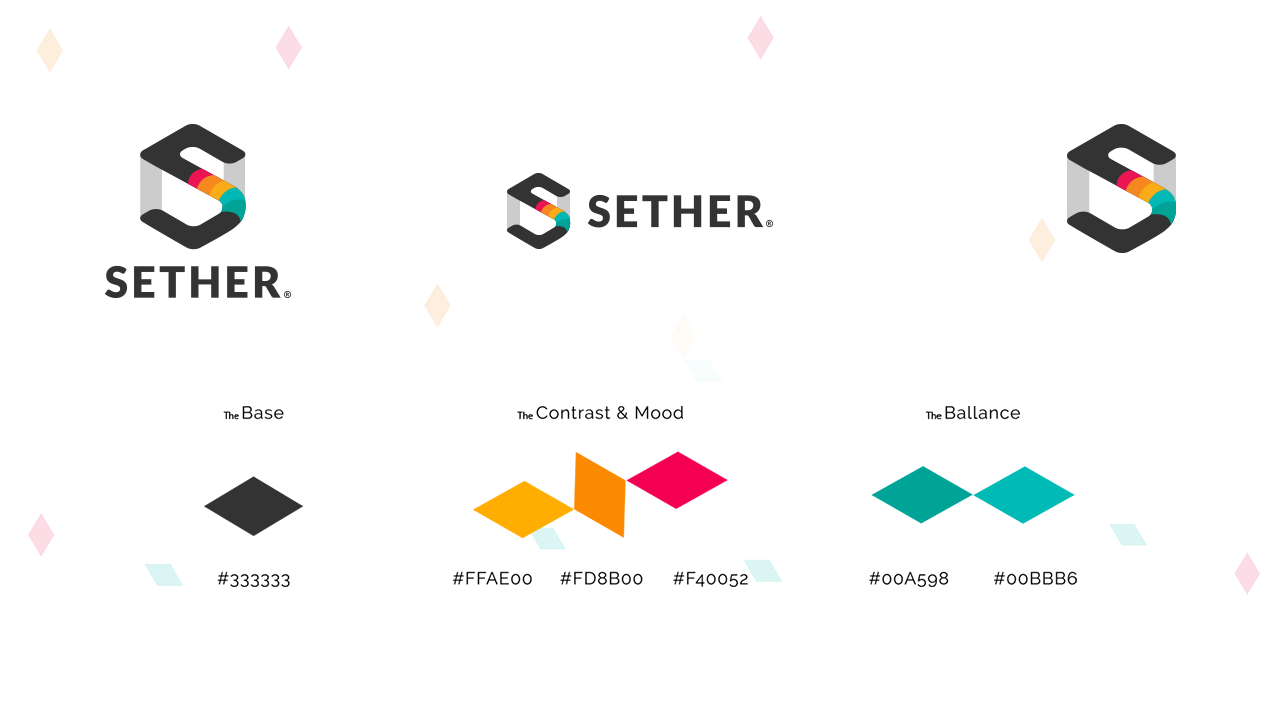
The visual design needed to communicate trust and professionalism while feeling modern enough for a blockchain product. I developed the brand identity in parallel with the UI, ensuring consistency across the product, pitch materials, and marketing.
Cannes Lions: proof of concept
We timed MVP completion to coincide with Cannes Lions 2018. The advertising industry’s biggest annual event and exactly the audience we needed in one place. Brand representatives understood the value of verified third-party performance data the second they saw the dashboard. Agency representatives saw locked objectives and automatic payment as the answer to two of their oldest frustrations.
We left Cannes with demo commitments from:
- Adidas
- SkyTV UK
- P&G
Not casual “let’s stay in touch” lines. “When can you show this to our team” commitments from three of the largest advertisers in the world.
What I carried out of it
The biggest challenge wasn’t the design work. It was learning to think inside blockchain constraints. Smart contracts don’t have an “edit” button. Immutable records don’t have an “undo.” Decentralized verification doesn’t have a “trust me on this.” I couldn’t design an “edit your KPIs” feature because the whole point was that KPIs couldn’t be edited once locked. I couldn’t add a “cancel campaign” button because that’s not how smart contracts work.
So the constraints stopped being constraints and started being the product. The thing that made the technology hard to design for (that you couldn’t change your mind mid-flight) was exactly what both sides of the relationship had been asking for.
Two lessons I’ve taken into every project since:
- Domain expertise compounds. Eleven years in advertising meant the research wasn’t a research project. It was conversations with people I already knew. The honesty of the answers was upstream of the design.
- Sometimes the constraint is the feature. When a technology forces a hard limit, the question to ask isn’t “how do we work around it?” It’s “what would this limit be worth to a user who actually wants it?” Locked KPIs and forced-settlement weren’t bugs of blockchain. They were what the market was asking for.
Shall we collaborate?
Either way, let's start with a short meeting so you get to know me even better and I you.
Let's start with "Hello there!"